A proper delivery risk assessment must produce a matched set of route, carrier and control decisions that cut the shipment’s exposure and let you recover fast if something goes wrong. That means a confirmed route plan, named security controls, a written carrier brief, and proof that tracking and insurance are active before the vehicle moves. Demand documented equivalents to TAPA’s Trucking Security Requirements, independent tracking and a signed proof of delivery. Frphaulage builds every same-day job around exactly this output.
TL;DR:
- Most shipment risks can be mitigated by verifying documentation, insurance, and route security within the first 15 minutes before booking.
- Classifying shipments accurately by value and sensitivity ensures appropriate protection levels without overspending or under-protecting.
- Key vulnerability points include origin yards, unmanned stops, and final approach routes; pre-approved secure rest bays and route variation enhance safety.
- Layered controls combining physical, procedural, and technological measures are essential to prevent theft, with independent tracking and tamper-evident seals being critical.
- Matching security spend to the actual risk profile prevents waste and maximizes protection, supported by documented custody and clear subcontractor visibility.
Table of Contents
- Delivery risk assessment checklist: what to do in the first 15 minutes
- How do you classify shipment risk by value and sensitivity?
- Where is a delivery route most vulnerable to risk?
- What controls actually reduce delivery risk?
- Insurance, documentation and proof-of-delivery: what to lock down first
- How do you verify and brief a carrier before booking?
- What happens if something goes wrong in transit?
- What regulatory compliance risks apply during delivery?
- Managing supplier and subcontractor risk during shipment
- Is the extra security spend worth it? A cost-benefit view
- How Frphaulage builds these checks into every urgent run
- Book a pre-movement risk check with Frphaulage
- Sources
Delivery risk assessment checklist: what to do in the first 15 minutes
Before you book anything, run through this sequence. It takes less time than reading a carrier’s terms and conditions, and it catches most of the mistakes that lead to disputed claims.
- Classify the shipment as high, medium or low risk based on value, urgency and handling needs (fragile, temperature-controlled, hazardous).
- Check documentation and insurance are in place before dispatch, not promised for later: declared value, cover limits, and any exclusions that apply to your cargo type.
- Plan the route with stop discipline. Avoid unscheduled halts in the first 200 miles or four hours after departure, when origin-zone theft crews are most active, and pre-select secure rest bays for longer runs.
- Set tracking and change-control rules. Insist on independent, first-party tracking rather than carrier milestone updates alone, tamper-evident seals on any sealed load, and one named contact authorised to approve route changes.
None of this needs a specialist consultant. It needs fifteen minutes, a shipment description, and a carrier willing to answer specific questions rather than give vague reassurance.
How do you classify shipment risk by value and sensitivity?
Not every parcel needs the same level of protection, and treating a pallet of stationery the same as a consignment of medical devices wastes money on one and under-protects the other. The judgement call has two parts: financial exposure and how hard the item is to replace or explain if it goes missing.
- Financial value and replacement difficulty: a £2,000 laptop batch is expensive but replaceable within days; a bespoke machine tool component might cost less but stop a production line for weeks if it’s late.
- Non-financial sensitivity: fragility, confidentiality (legal documents, prototypes), regulatory sensitivity (pharmaceuticals, controlled goods), and theft appeal (electronics and branded goods attract organised crews more than raw materials).
- The result should be a three-tier class: low risk (standard handling, tracked delivery, signed POD), medium risk (sealed packaging, route review, independent tracking), and high risk (TAPA-aligned carrier controls, named escort or convoy consideration, and real-time geofencing alerts).
Get this classification wrong in either direction and you either overspend on low-value freight or leave a genuinely vulnerable shipment under-protected.
Where is a delivery route most vulnerable to risk?
Every route has weak points, and they cluster in predictable places: origin yards, motorway service stops, unmanned handover points, and the final approach to destination. Mapping the movement means checking more than distance and time.
- Physical route checks: congestion patterns, bridge and height restrictions, and any segment with a known history of theft or interference on that corridor.
- Secure-stop planning: pre-approve rest bays rather than letting a driver choose on the day, and vary times and routes on recurring runs so the schedule isn’t predictable to anyone watching it.
- Data sources worth using: incident history where a carrier can share it, mapping tools for congestion and diversions, and local police liaison for genuinely high-value moves through known hotspot areas.
TAPA’s 2026 guidance treats annual route and stop risk assessment as a baseline security procedure, not an optional extra for high-value fleets only.
What controls actually reduce delivery risk?
Layering matters more than any single control. Physical hardware stops opportunistic theft, procedures stop insider risk and confusion, and technology closes the visibility gap between the two. Relying on just one leaves an obvious gap for anyone determined enough to find it.
- Physical controls: appropriate vehicle selection for the load, ISO 17712-rated high-security seals on sealed loads, discreet packaging that doesn’t advertise contents, and reinforced lock points on the vehicle itself.
- Procedural controls: a single authorised contact for any route or timing change, sensitive movement details shared on a strict need-to-know basis, and a documented custody sign-off at every handover.
- Technological controls: independent trackers with geofencing and real-time alerts for deviation or unauthorised door opening, which give you an actual window to react rather than a milestone update after the fact.
Carrier milestone scans tell you where a shipment was an hour ago. Device-generated tracking data tells you where it is now, and that gap is exactly where most cargo theft goes undetected until it’s too late.
For a medium-risk consignment, pairing a tamper-evident seal with independent tracking and a single-contact change policy usually covers the exposure. For high-risk cargo, add TAPA-aligned vehicle and route requirements and consider a documented escort for the highest-value runs.
Once cargo is stolen, recovery odds fall sharply: around 74% of stolen freight is never recovered, which is exactly why prevention and early detection carry more weight than any recovery plan built after the fact.
Pro Tip: Treat the first 200 miles or four hours after departure as the highest-risk window on any run. Origin-zone theft crews target vehicles before they’ve cleared the local area, so avoid unscheduled stops for fuel, food or rest until that window has passed.
Insurance, documentation and proof-of-delivery: what to lock down first
Carrier liability cover and declared-value cargo insurance are not the same thing, and confusing them is one of the most common reasons claims get rejected after loss or damage. Standard carrier liability is often capped low per kilogram and excludes categories like cash, artwork or perishables entirely, so check the policy wording against your actual cargo, not the summary paragraph.
Before goods leave your premises, capture:
- The commercial invoice and packing list showing declared value and contents.
- Photographs of the goods and packaging condition at pickup.
- Seal numbers recorded and matched against the airway bill or consignment note (AWB/LR).
- A signed proof of delivery with condition remarks, not just a signature on a screen.
Poor documentation is one of the most common reasons a genuine claim gets contested, because an insurer with no photographic record and no seal reference has nothing to verify a damage or shortage claim against.
How do you verify and brief a carrier before booking?
A carrier that can’t answer specific questions about driver identity, vehicle registration and subcontracting policy shouldn’t be handling anything you’d call medium or high risk. Read our guide on choosing a same-day courier for the full vetting process, but the minimum brief covers:
- Driver and vehicle checks: confirmed driver identity, vehicle details, and evidence the carrier uses a vetted partner network rather than open-market subcontracting.
- Contract clauses to insist on: no unauthorised subcontracting without notice, documented custody handovers at every stage, and a stated notification window if the route or timing deviates.
- Your booking brief should specify: the approved route, designated stops, tracker IDs where fitted, and exactly who is authorised to approve any change once the vehicle is moving.
What happens if something goes wrong in transit?
Speed of response matters more than the plan looking good on paper. Decide these contacts and steps before a shipment leaves, not during a call at 2am.
- Set the intervention window in advance. Pre-established recovery contacts, whether that’s local police or a service like CargoNet, materially improve recovery odds versus starting from scratch after the fact.
- First actions on an unauthorised stop or deviation: the tracking alert triggers, the authorised contact is notified immediately, and the carrier confirms driver status within minutes, not hours.
- Escalate to police and insurer in parallel, not sequentially, once deviation is confirmed rather than assumed.
- Collect evidence as it happens: timestamped tracking data, photographs of any tampering, and a written incident log, all of which support both a recovery attempt and the insurance claim that follows it.
What regulatory compliance risks apply during delivery?
Compliance failures during transit rarely show up as dramatic events. They show up as delayed goods, confiscated cargo, or a claim an insurer refuses to pay because a legal requirement was missed before dispatch. The risk sits in three areas: what you’re allowed to move, how it must be documented, and who is licensed to move it.
Controlled or restricted goods (certain chemicals, pharmaceuticals, high-value electronics crossing borders) carry licensing and documentation requirements that vary by category and destination. Check these before booking, not after the vehicle is loaded, because a compliance gap discovered mid-route usually means the shipment gets held rather than delivered late.
Driver hours and vehicle roadworthiness rules affect route feasibility directly. A route that looks fastest on a map may be undeliverable within legal driving-hour limits, forcing an unplanned stop exactly where you didn’t want one. Ask any carrier how they plan for this rather than assuming it, since an unplanned break defeats the stop-discipline planning covered earlier.
Where cargo crosses jurisdictional boundaries, even within the UK’s own regulatory categories for hazardous or restricted goods, documentation has to match the load precisely. A mismatch between declared contents and the paperwork is one of the more common reasons a shipment gets delayed at a checkpoint, and that delay itself becomes a risk event worth planning around, not an afterthought.
Managing supplier and subcontractor risk during shipment
Every handover between a business and its named carrier is a point where custody, accountability and visibility can slip, and subcontracting multiplies that risk quietly. A carrier that quotes competitively but subcontracts to an unknown third party without telling you has handed your cargo to a business you never vetted.

This is why the contract clauses matter as much as the initial vetting. Insist on written notice before any subcontracting happens, and treat a refusal to commit to that in writing as a warning sign rather than a formality. A vetted partner network, where every subcontractor has already been checked against the same standards as the primary carrier, closes this gap before it opens.
Ask specifically who will be driving, what vehicle will be used, and whether that vehicle and driver match what was booked. A last-minute swap to an unnamed subcontractor, discovered only when a different van turns up, is exactly the kind of custody gap that makes an insurance claim harder to support later. Documented custody handovers, where each party signs for the goods at every transfer point, are what turn a vague “it went missing somewhere along the route” into a traceable chain that points to exactly where responsibility sits.
For recurring business account runs, this matters even more, because the temptation to subcontract grows with volume. Build subcontracting visibility into the ongoing brief, not just the one-off booking, and review it periodically rather than assuming it stays consistent.
Is the extra security spend worth it? A cost-benefit view
Every layered control has a cost, and not every shipment justifies the same spend. The calculation is simple in principle: weigh the cost of the control against the expected cost of the loss it prevents, adjusted for how likely that loss actually is.
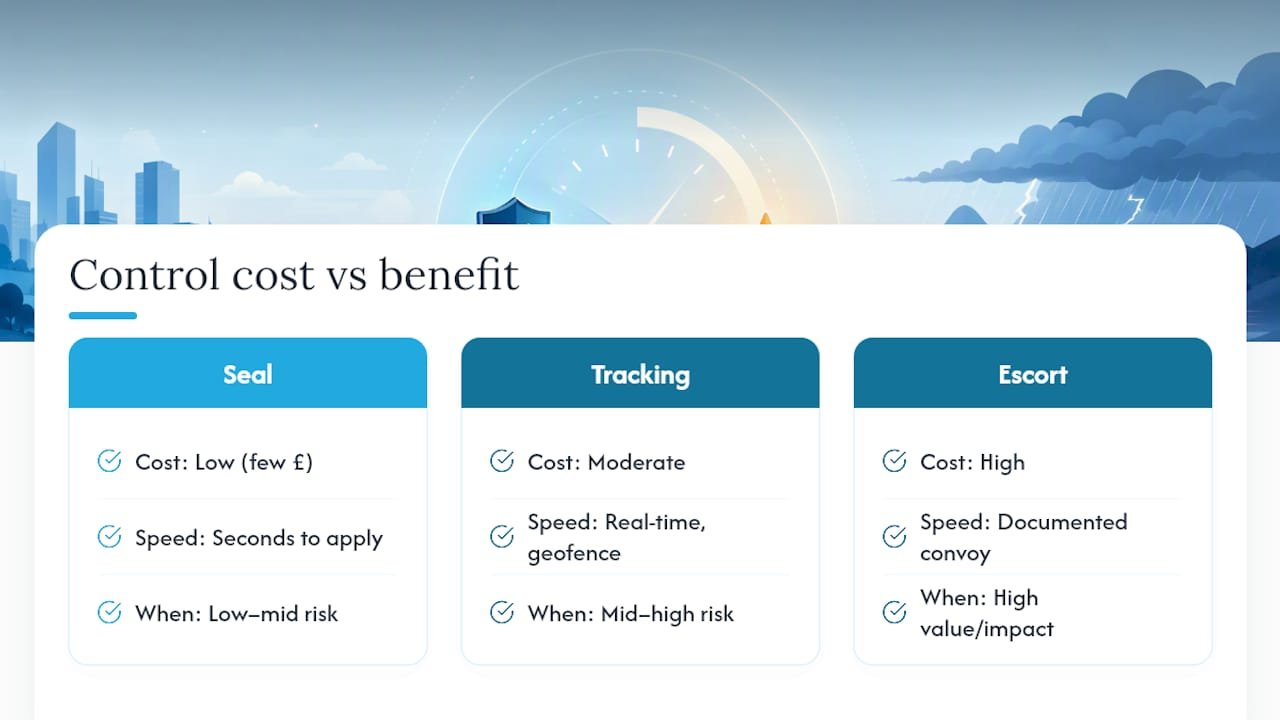
A tamper-evident seal costs a few pounds and takes seconds to apply. Independent tracking with geofencing costs more but pays for itself the first time it catches a deviation before goods disappear rather than after. A documented escort or convoy for the highest-value loads costs significantly more again, and it’s only justified when the cargo value or operational impact of loss genuinely warrants it.
The mistake most businesses make isn’t underspending on security. It’s applying the same level of control to every shipment regardless of risk tier, which means overspending on low-risk parcels while occasionally under-protecting something that actually needed the extra layer. Matching safeguards to the specific shipment profile, rather than running one security plan for everything, is what makes the spend proportionate rather than wasteful.
Run the numbers against your own claim history if you have one. A business that’s had two disputed claims in the last year over missing documentation has a clearer cost-benefit case for tightening the document pack than for buying a more expensive tracker. The right control depends on where your actual losses have come from, not on which control sounds most impressive.
How Frphaulage builds these checks into every urgent run
Frphaulage runs this checklist on same-day and urgent jobs as standard, not as an add-on. Rapid collection within 60 to 120 minutes still starts with shipment classification, and every job moves through the personal fleet or vetted partner network with signed proof of delivery on arrival. On sensitive or high-value runs, pre-movement checks have flagged handling issues before dispatch rather than after a delay. Ask for a pre-movement risk check on your next booking and see the difference it makes.
— Catalin
Book a pre-movement risk check with Frphaulage
Frphaulage is the practical route to everything this checklist demands, without needing to build a security programme from scratch. Same-day collection within 60 to 120 minutes, a personal fleet backed by a vetted partner network, and a signed proof of delivery on every job mean the controls covered above aren’t theoretical, they’re what happens on the run.
Whether it’s a single urgent parcel or a scheduled multi-drop account, request a pre-movement risk check before you book and get route, carrier and control decisions confirmed in advance rather than discovered mid-transit. Read how to choose a same-day courier service for the full brief, then get in touch to arrange collection.
| Commitment | What it covers |
|---|---|
| Collection window | 60 to 120 minutes |
| Fleet | Personal fleet plus vetted partner network |
| Proof | Signed proof of delivery on every shipment |
Get a same-day quote through Frphaulage and have your next shipment assessed before it leaves the yard.
Sources
- TAPA TSR 2026 standard (highlighted)
- Handling high-value cargo shipments — what experts do differently